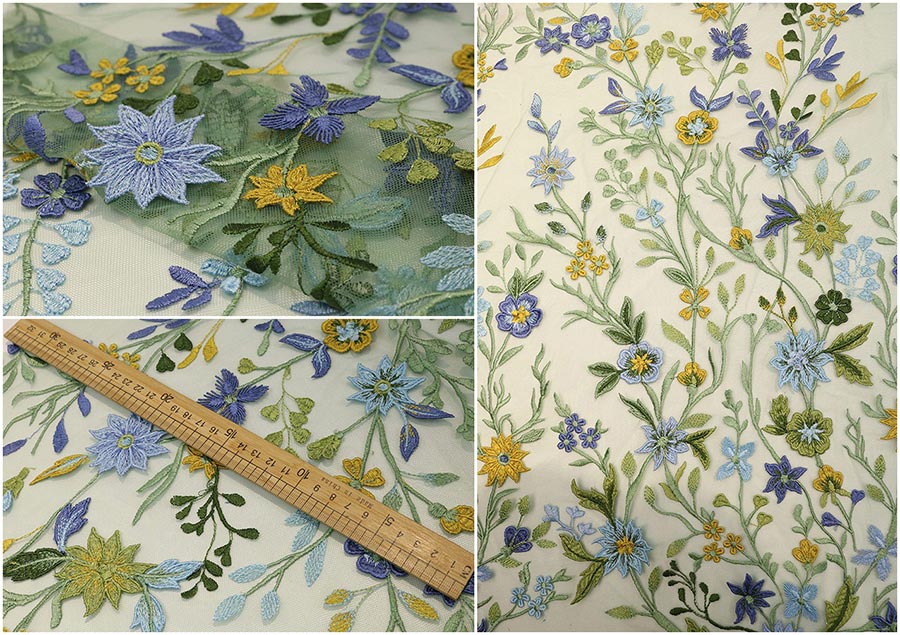
Much of Naying Textile’s fabric development does not start with picking a design out of a catalogue. It starts with a design direction that a brand brings to us.
This case documents one such project: a colorful plain embroidery fabric co-developed with a European fashion brand, referred to here as YY, moving from a hand-drawn artwork through a confirmed sampling instruction sheet to a finished garment application.
Project Key Facts
- Case Reference: YY-260330
- Product Form: Embroidered garment panel, cut to size for sewing rather than supplied as continuous yardage
- Fabric Direction: Multi-color plain embroidery on a woven satin base, embroidery only, no jacquard process involved
- Base Fabric: Customer-supplied beige base fabric, Naying Textile developed the embroidery
- Embroidery Colors: Deep purple, light purple and off-white flower tips, with deep green and light green foliage
- Color References: Black Plum and Aster Purple for the flower heads, Vanilla Ice for the flower tips
- Panel Width: 50 cm
- Panel Height: 70 cm
- Motif Size: Embroidery width at top 14 cm, overall embroidery height 35 cm, maximum embroidery width 30 cm
- Motif Position: Embroidery starts 10 cm below the top edge of the panel
- Embroidery Finish: Full matte effect
- Sampling Window: March 31 to April 4
- Development Stage: Design artwork, sampling instruction sheet, garment application
Where Did This Case Start?
The customer did not arrive with a finished, production-ready fabric design. The customer arrived with a development direction: a garden-style trailing floral embroidery, a soft military green or off-white ground, flower heads mixing deep and light purple, and leaves built in two green levels.
The base fabric was also supplied by the customer, a beige woven satin cloth. This shaped the project as a customer-supplied base with embroidery development on our side: the customer holds the base fabric, and Naying Textile develops the motif and the embroidery technique onto it. Embroidery is the only process used, so Naying Textile does not weave the base, it simply completes the embroidery on the ready-made satin base.
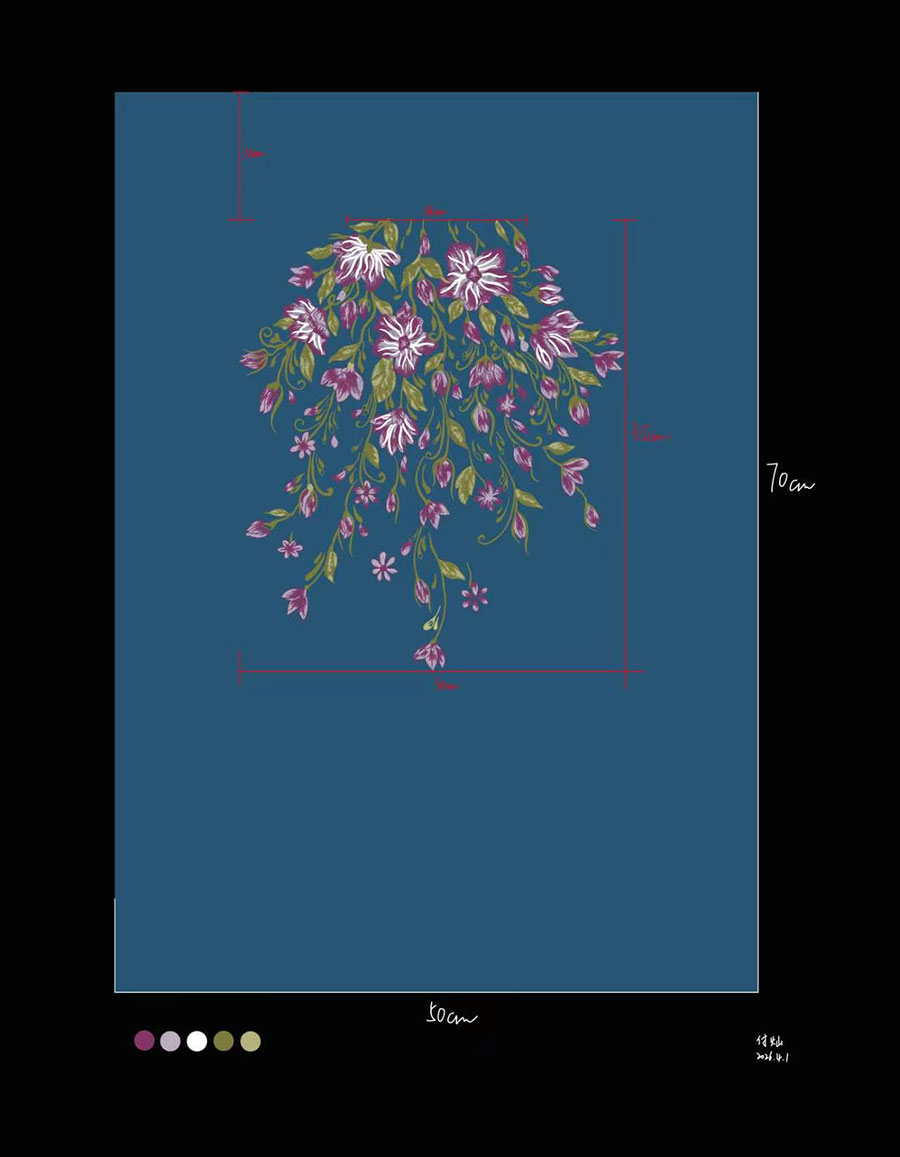
This project produced an embroidered garment panel rather than continuous yardage. The 50 cm by 70 cm size is the actual panel dimension, already laid out to suit sewing, so the embroidery position, the margins and the distances above and below are all set for direct cutting and sewing rather than as sampling references.
Naying Textile started from that direction, developed the artwork, discussed the stitch method and embroidery technique, and turned it into a panel that could be sampled.
Artwork Stage: Turning a Direction into a Producible Pattern
The first step was the artwork. The design uses trailing florals as its main structure, with a cluster of open blooms spreading outward at the top, stems trailing downward, and the lower end closing with small flowers and buds. Three things were settled at this stage:
- Pattern structure. The direction and density of flowers, leaves and vines were fixed first, keeping the flower heads concentrated in the upper section and leaving the lower part progressively lighter.
- A five-color palette. Flower heads combine deep purple, light purple and off-white, with off-white lifting the flower tips, while the leaves build volume from a light green layer over a deep green layer.
- Panel dimensions. Each panel was set at 70 cm high and 50 cm wide, with the embroidery 14 cm wide at the top, 35 cm tall overall, and 30 cm at its widest point.Color matching is confirmed at the artwork stage. Purple tones easily shift toward red or grey in bulk production, so the flower colors are locked against a color card on the artwork, and once the customer approves them they go straight into the sampling instruction sheet.
Sampling Instruction Sheet Stage: Turning Artwork into Production Standards
After the artwork was approved, the project moved to sampling. At this step Naying Textile issues a sampling instruction sheet that translates the visual information on the artwork into parameters the workshop can execute directly. The sheet records:
- Sampling begins only after the artwork and the stitch method are confirmed.
- The base fabric is the beige woven satin supplied by the customer.
- The panel is made as a full 70 cm x 50 cm piece, with corresponding margins above and below.
- The embroidery starts 10 cm below the top edge of the panel.
- The embroidery measures 14 cm at the top, 35 cm tall and 30 cm at its widest.
- Embroidery thread colors follow the color card, and the full matte effect is specified.
The line about confirming the artwork and stitch method before sampling is the most cost-saving step in this process. Once the stitch method changes, the direction of the motif, thread consumption and embroidery density all change with it. Locking the stitch method before sampling removes an entire round of samples.
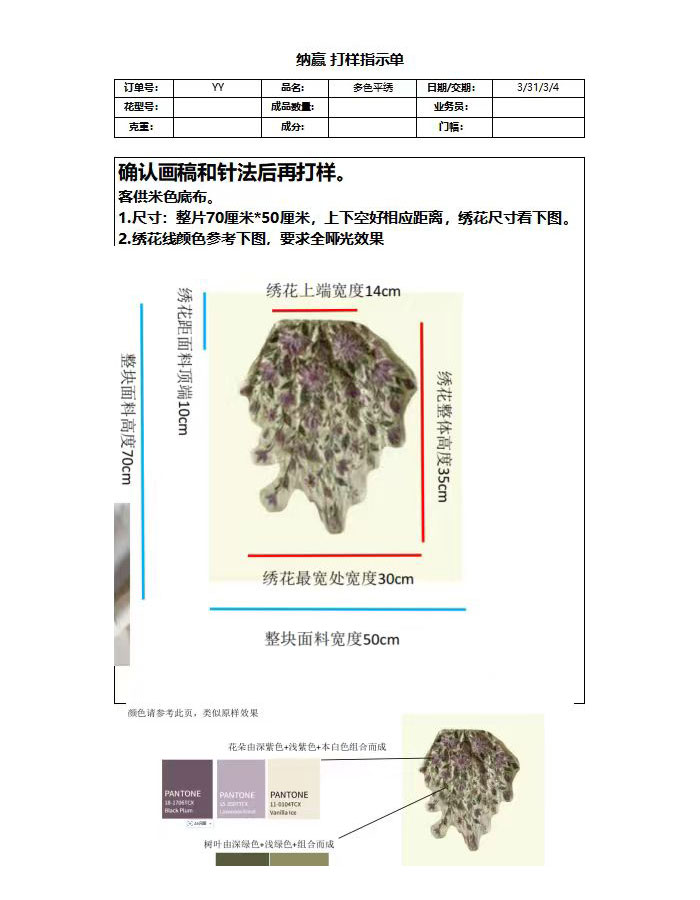
The sheet also lists specific Pantone references: Black Plum for the deep purple flower heads, Aster Purple for the light purple, and Vanilla Ice for the off-white tips, with two further greens specified for the foliage. Once these references are on the sheet, embroidery threads across different production runs can be aligned to a single standard.
Garment Stage: How the Fabric Looks Once It Becomes a Garment
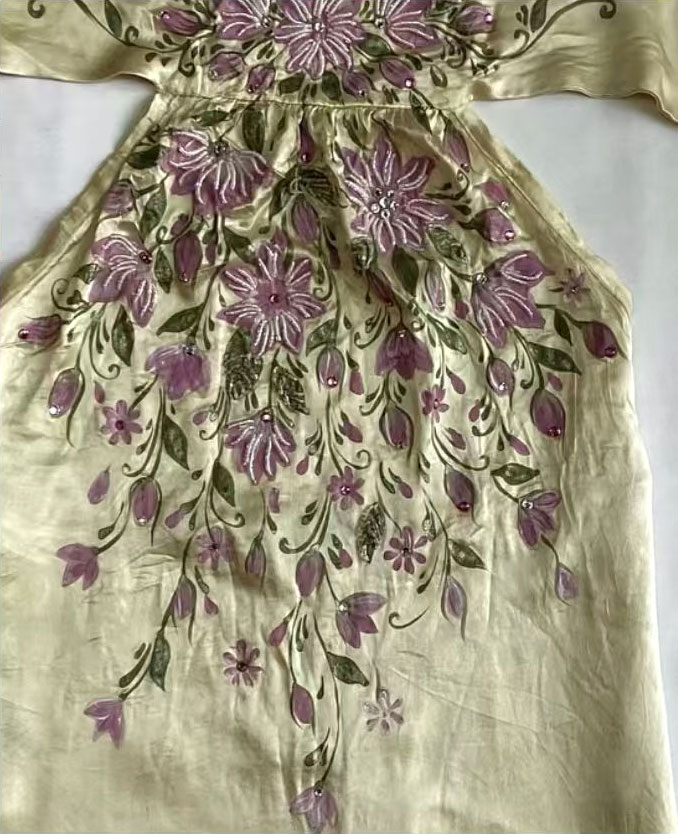
After sampling, the panel was made into a garment. On the finished garment the base is a pale gold satin with an olive green cast, with purple floral stems trailing down from the shoulder line, the flower heads concentrated across the upper body and gradually thinning toward the hem for a dense-to-sparse gradient. Hotfix rhinestones accent the flower centers and buds, so the soft sheen of the satin and the refracted light of the rhinestones give the garment two distinct types of gloss.
The same artwork takes on a different character on a different base. During sampling this motif was matched with the beige woven satin supplied by the customer, while the finished garment uses a pale gold satin with an olive green cast, where the purple stems read softer on beige and warmer on gold. The embroidery threads themselves are finished in a full matte treatment, so the flowers and leaves do not reflect light, leaving the satin and the rhinestones as the only two sources of shine on the garment. That is part of what the customer-supplied base arrangement offers: the artwork and the embroidery technique are developed once and can then follow the customer’s own base fabric.
What Does Co-Development Offer Fashion Brand Buyers?
Co-development like this addresses the practical concerns brands raise most often: differentiation, development risk and communication.
Differentiation comes first. Plain embroidery fabrics on the market are often the same motif with a swapped ground color, which makes for garments that look alike. When development starts from the artwork, Starting from a brand’s own design direction can reduce the risk of using a motif that is already common in the market and can help create a more distinctive product identity, with no risk of a competitor carrying the same design.
Development risk comes next. Brands often have a clear design direction but no certainty that it can be produced as a fabric. Naying Textile’s approach is to turn the direction into an artwork, then turn the artwork into a sampling instruction sheet, locking the stitch method and color references before sampling begins. The first sample a customer sees is therefore closer to the final product.
Communication is the third part. Through the whole process the customer only needs to confirm three things: the direction of the artwork, the stitch method and panel layout, and the look of the sample. The embroidery details, thread selection and the matte treatment are handled on our side.
What Co-Development Needs Can Naying Textile Take On?
Naying Textile specializes in the development and supply of fashion fabrics across embroidery, lace, sequins, jacquard, crochet and warp knitting.
If you already have a fabric sample, a reference image, a design sketch, a garment reference or simply an initial idea, you can bring it to Naying Textile to discuss whether it could become a co-development project. Once the direction is confirmed, we can provide motif design and fabric development support based on your product positioning and target market.
If you have a fabric direction under consideration, or would like to develop something differentiated based on a similar trailing floral embroidery, contact us to request samples and discuss a development plan.
Relative FAQs
Q: Can a customer supply the base fabric for a co-development project?
A: Yes
Q: Can a customer supply design concept for a co-development project?
A: Yes
Q: Can a customer supply sketches for a co-development project?
A: Yes
Q: What is fabric co-development at Naying Textile?
A: Fabric co-development means that Naying Textile and a customer work together from an initial design concept or product requirement, instead of simply choosing from existing fabrics. Read More …